Alessia Romani

Design & Engineering Research

Low-Cost Open-Source Melt Flow Index System for Distributed Recycling and Additive Manufacturing


Journal article


Dawei Liu, Aditi Basdeo, Catalina Suescun Gonzalez, Alessia Romani, Hakim Boudaoud, Cécile Nouvel, Fabio A. Cruz Sanchez, Joshua M. Pearce*
Materials, vol. 17(23), 2024 Dec, p. 5966

DOI: https://doi.org/10.3390/ma17235966

View PDF DOI LINK Google Scholar
Cite

Cite

APA   Click to copy
Liu, D., Basdeo, A., Gonzalez, C. S., Romani, A., Boudaoud, H., Nouvel, C., … Pearce*, J. M. (2024). Low-Cost Open-Source Melt Flow Index System for Distributed Recycling and Additive Manufacturing. Materials, 17(23), 5966. https://doi.org/ https://doi.org/10.3390/ma17235966


Chicago/Turabian   Click to copy
Liu, Dawei, Aditi Basdeo, Catalina Suescun Gonzalez, Alessia Romani, Hakim Boudaoud, Cécile Nouvel, Fabio A. Cruz Sanchez, and Joshua M. Pearce*. “Low-Cost Open-Source Melt Flow Index System for Distributed Recycling and Additive Manufacturing.” Materials 17, no. 23 (December 2024): 5966.


MLA   Click to copy
Liu, Dawei, et al. “Low-Cost Open-Source Melt Flow Index System for Distributed Recycling and Additive Manufacturing.” Materials, vol. 17, no. 23, Dec. 2024, p. 5966, doi: https://doi.org/10.3390/ma17235966.


BibTeX   Click to copy

@article{dawei2024a,
  title = {Low-Cost Open-Source Melt Flow Index System for Distributed Recycling and Additive Manufacturing},
  year = {2024},
  month = dec,
  issue = {23},
  journal = {Materials},
  pages = {5966},
  volume = {17},
  doi = { https://doi.org/10.3390/ma17235966},
  author = {Liu, Dawei and Basdeo, Aditi and Gonzalez, Catalina Suescun and Romani, Alessia and Boudaoud, Hakim and Nouvel, Cécile and Sanchez, Fabio A. Cruz and Pearce*, Joshua M.},
  month_numeric = {12}
}
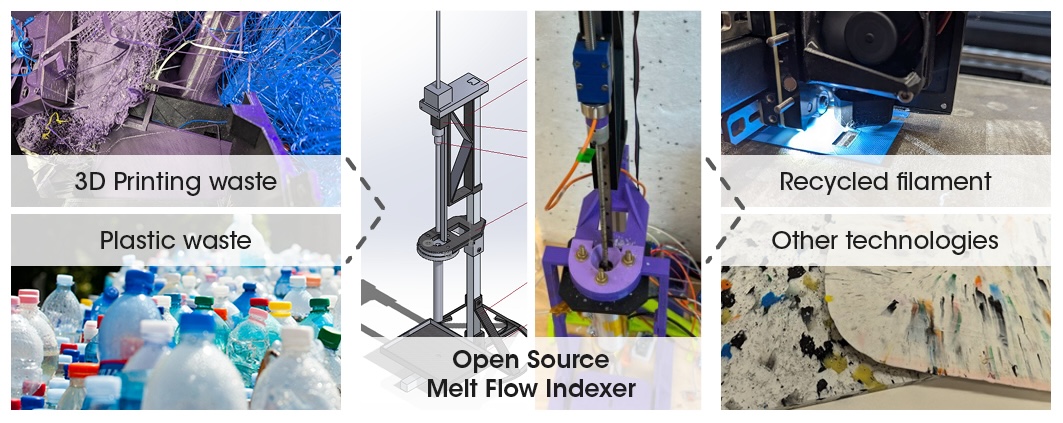
Abstract

The increasing adoption of distributed recycling via additive manufacturing (DRAM) has facilitated the revalorization of materials derived from waste streams for additive manufacturing. Recycled materials frequently contain impurities and mixed polymers, which can degrade their properties over multiple cycles. This degradation, particularly in rheological properties, limits their applicability in 3D printing. Consequently, there is a critical need for a tool that enables the rapid assessment of the flowability of these recycled materials. This study presents the design, development, and manufacturing of an open-source melt flow index (MFI) apparatus. The open-source MFI was validated with tests on virgin polylactic acid pellets, shredded recycled poly(ethylene) terephthalate glycol flakes, and high-density polyethylene/poly(ethylene) terephthalate blends to demonstrate the range of polymer types and recyclability. The proposed MFI tool offers a user-friendly and cost-effective solution for evaluating the flow properties of materials from waste streams, thereby enhancing their viability for additive manufacturing applications. 1

Alt text


Keywords

material extrusion // material properties // melt flow index // open hardware // polymers // recycling // rheology // thermal properties


Highlights

  • Distributed recycling via additive manufacturing (DRAM) demands material properties.
  • Recycled materials frequently contain impurities and mixed polymers.
  • News design, development, and manufacturing of an open-source melt flow index (MFI) apparatus.
  • MFI tool offers a user-friendly and cost-effective for evaluating the flow properties of materials.


Media Coverage

  • Melt Flow Index (Wikipedia page). 2


Resources and links

  • 📑 Full text (publisher version) 3
  • 📝 Full text (preprint version) 4
  • 🛠️ OSF Repository (3D models and dataset) 5


[Picture]
OSHWA Certified Open Hardware


The OS MFI Apparatus is an Open Source Hardware Educational Tool certified by OSHWA (Open Source Hardware Association), released under the CERN-OHL-S-2.0 (hardware and documentation) and GNU General Public License (GPL) 3.0. (software).

  • Certified Open Hardware - OSHWA UID CA000059 (Certification, license, and links) 1